
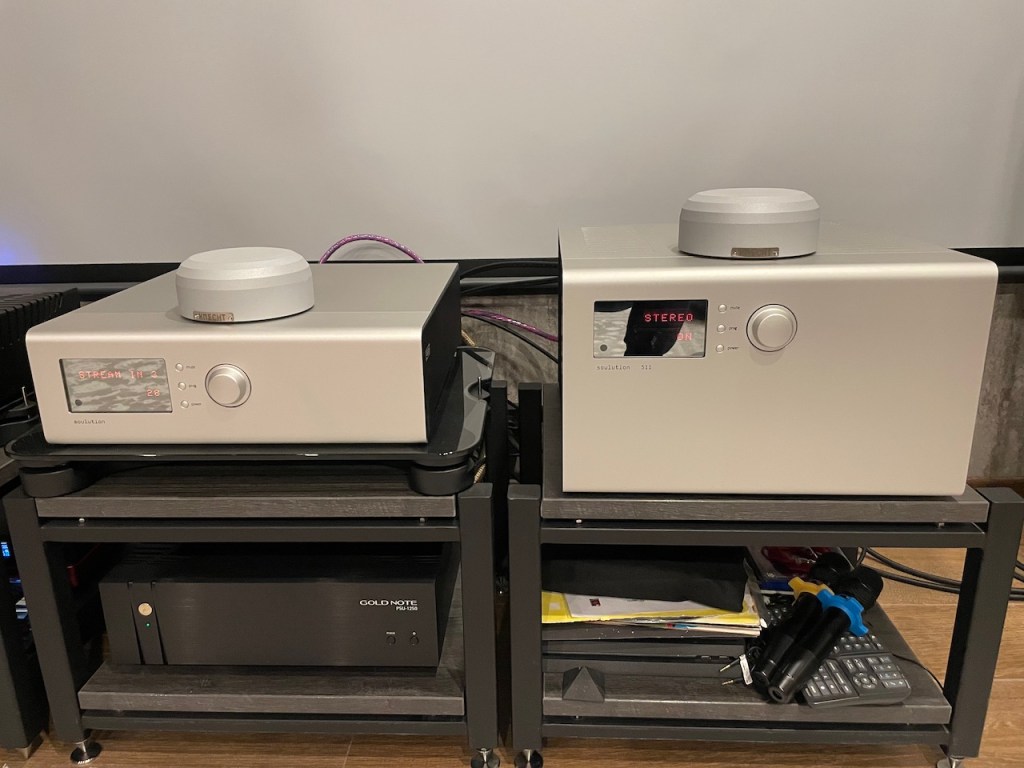
Why your system will be able to sound better
Some would say that the audio industry has been doing just fine without damping for 100 years and that it is unnecessary. But imagine your car’s suspension with springs and no shock absorbers, then after each bump the car will oscillate like a wave for a long time until it meets the next bump. Probably some drivers will suffer from seasickness when driving. The auto industry has long since come to realise the need for damping and has fitted cars with shock absorbers of various types, while the audio industry has lagged behind, paying more attention to the appearance of the devices and their engineering excellence.
Vibration isolation in the audio industry is relatively new in the 90’s and many people think it is enough. However, it should be realised that isolation and damping are not identical. Of course the two processes aim to minimise vibration in devices and complement each other, but they are fundamentally different. Again, let’s imagine a car with perfect suspension that compensates for all road irregularities and the driver should feel bliss in the cabin. However, if the engine is unbalanced, the car will shake itself. To compensate for the engine unbalance, special cushions are used to absorb the engine shake. So a comfortable ride requires not only protection against external vibrations, but also against internal vibrations.
Our experiments and measurements show that the vast majority of audio system owners have not realised the potential of their existing set of equipment. A useful signal received from a vinyl record, CD or streaming in the process of sound extraction grows a lot of distortions, for which low-level and quiet signal is lost behind noise, as a consequence, the sound loses its naturalness and gives the impression of flat and meagre.
Many people need a ‘reference point’ or the best audio system to compare the sonic performance of their own or a third-party audio system, the use of which for comparison purposes or to guide the improvement of their own set of audio components provides a baseline. However, imagine that the vast majority have no idea of the fullness of a system’s sound without comparing it to the natural sound of musical instruments or visiting the halls of a philharmonic or opera house. Human hearing quickly adapts to unnatural and distorted sound, and our brains quickly learn to filter out distorted audio information and reconstruct missing sounds. The lack of a proper ‘reference point’ causes many audiophiles to misjudge the sound quality characteristics of their audio systems. This leads to the wrong ‘path’ in improving a system in the absence of beacons (understanding what is lost and where to aim). All of us have heard small portable speakers and we can easily distinguish any musical instruments in them, as our hearing adapts and moulds the lost sound material.
For comparative tests, Knecht Audio invited musicians and music educators to find out the differences between the sound of an audio system with and without DampEcht, StandEcht devices. The hearing of people whose work constantly involves listening to real musical instruments is very sensitive to distortion and loss of timbres and harmonics, sound impoverishment and unnaturalness. Numerous listening sessions with chamber music, symphonic music or acoustic recordings have confirmed a significant improvement in the sound of audio systems of different levels of cost from $2,000 to $600,000.
Often audiophiles go the way of tube technology, which introduces its own harmonic distortion into the useful signal. The anode grid in tubes starts to vibrate during the operation of the device, thus introducing unnecessary harmonic distortion into the audio signal. The inclusion of tube technology in the tract, which fills the signal with its own echoes, mistakenly seems to be a salvation to revive the sounds of acoustic instruments and voice, and this explains the love of many people for tube technology. Subconsciously, a sound that is rich in timbre seems more pleasant and natural. In the same way, some loudspeakers, wooden and undamped (the cabinet has a certain mobility, the walls are deliberately reduced in thickness and not processed from inside) cabinets of which ‘play along’, add harmonics and overtones to the sound, operate in the same way. The case of such loudspeakers like a grand piano deck or a violin case starts to sound together with the speakers, and the sound is filled with external resonances and overtones. We would like to note that such acoustic systems qualitatively stand out against the background of others, records with acoustic instruments come to life, sound brighter. However, this misconception is erroneous, it is like increasing the colour on a faded photo in a graphic editor. When information at the first stage is lost or erased by noise (in digital photos taken in low light, colour information is also lost behind matrix noise), it is wrong to restore it by artificially adding harmonics. In the process of improving the performance of a stereo system, it is not always a good idea to buy new components in anticipation of a step up. Undoubtedly, new components will add performance, correct errors of simpler components in engineering terms, improve system characteristics, but it may be a step sideways, but not forward. The first thing to do is to prepare the vibration isolation and damping base on which the entire audio system will sit. Therefore, it is initially worth minimising the amount of detrimental noise in the useful signal, to make a ‘cleaning’.
Knecht Audio devices have been specifically designed to modernise existing audio components in private and professional systems. In order to improve the sound quality of the system, owners do not need to replace components with new ones, it is enough to include Knecht Audio devices in the system.
We are fully confident that the extremely important issue of isolation and damping of audio components is needlessly overlooked by electronics manufacturers and ignored by audio system owners.


